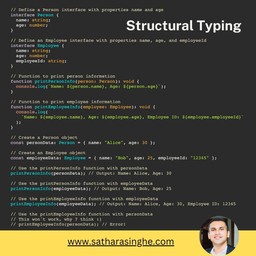
In the TypeScript universe, it’s all about what your data can do, not just its name. Welcome to the world of Structural Typing, often known as “Duck Typing.” 🌊
With Structural Typing, TypeScript doesn’t get hung up on labels; it’s all about the structure:
You define two objects, one as “Person” and the other as “Employee,” each with similar properties. TypeScript doesn’t fuss over the names; it’s all about the shape:
These two objects, despite different names, work harmoniously because their structures align. 🎯
So, when you craft functions or classes that work with types, TypeScript focuses on the shape of those types, not their labels. It’s akin to “if it walks like a duck, swims like a duck, and quacks like a duck, it’s a duck!” 🦆
This versatility empowers you to write code that’s more reusable and adaptable. It’s about defining how your data should look, not what it’s named. 🚀
Have you explored Structural Typing in TypeScript? Share your thoughts and experiences in the comments below! 👇
#TypeScript #DuckTyping #CodingFlexibility